
Iron-based
Iron-based powder is a raw material of alloy powder with iron as the main component, which is widely used in the fields of mechanical parts, 3C products, porous materials, tooling materials, magnetic materials, shielding materials, surface coatings, etc., and it is the raw material of powder metallurgy with a large dosage, and it has a high cost performance ratio.
HK30 Austenitic Stainless Steel Powder · Niobium-Stabilized Heat-Resistant Steel
High temperature: 1100°C · Resistant to carburization and sulfidation · Specifically designed for turbocharging, MIM, and 3D printing 15–53 μm / 53–150 μm / -500 mesh
Core Advantages of HK30 Stainless Steel Powder
Niobium stabilization · High temperature 1100℃
The Nb element effectively suppresses the precipitation of chromium carbides at grain boundaries, enhancing creep resistance, carburization resistance, and sulfidation resistance, enabling long-term service under severe conditions in the 800–1100°C range.
Excellent corrosion resistance, carburization resistance, and sulfidation resistance.
With high Cr (23–27%) and high Ni (19–22%) contents, it exhibits excellent stability in high-temperature and corrosive environments, making it particularly suitable for petrochemical cracking applications.
High sphericity · High tapped density
Atomized spherical powder with a flowability of ≤25 s/50 g and a tapped density of 4.4–4.9 g/cm³, enabling high‑loading feed rates while reducing binder costs and sintering shrinkage.
Multi-granularity · Multi-process adaptation
Available in a variety of particle sizes, including 15–53 μm, 53–150 μm, and -500 mesh, it is compatible with processes such as SLM, MIM, powder metallurgy, thermal spraying, and HIP.
Product Real-World Photos & Microscopic Morphology
 15–53 μm powder SEM
High sphericity, narrow particle size distribution, and excellent flowability.
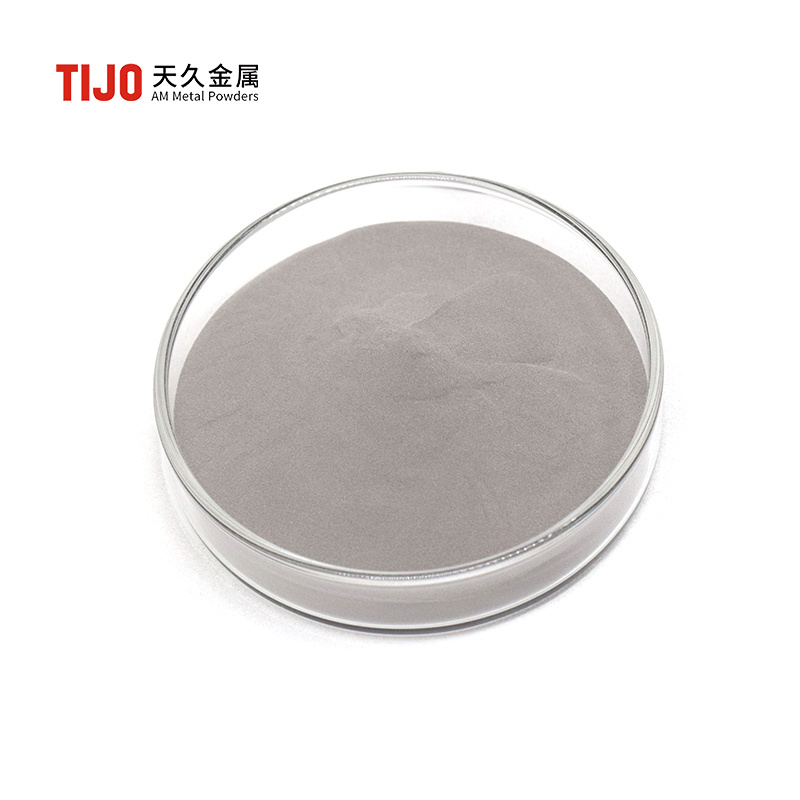
 Real-life photos of the powder
Gray powder, packaged in vacuum‑sealed aluminum foil bags or iron drums, with argon gas protection.
 Turbine supercharger/cracking furnace tube
Blades, exhaust gas recirculation components, and high-temperature furnace internal components
HK30 niobium-stabilized austenitic stainless steel powder
HK30 is a high-alloy heat-resistant steel, often classified as a nickel-based superalloy, exhibiting excellent high-temperature strength, oxidation resistance, and corrosion resistance. Its primary alloying elements are chromium (23–27%) and nickel (19–22%), while the addition of niobium (1.2–1.5%) provides stabilization, significantly enhancing its creep resistance, carburization resistance, sulfidation resistance, and oxidation resistance at elevated temperatures. Components manufactured from HK30 powder can maintain structural integrity under severe service conditions ranging from 800 to 1100°C. TIJO employs an inert-gas atomization process to produce spherical HK30 powder with a high tapped density (4.4–4.9 g/cm³), enabling high‑loading feed rates that reduce binder costs and minimize shrinkage during degreasing and sintering. This material is well suited for demanding operating environments at 600–650°C and even higher temperatures. It complies with ASTM A351/A351M and ASTM A608/A608M standards and finds extensive applications in core components of automotive turbochargers, petrochemical cracking furnace tubes, gas turbine blades, industrial furnace internals, and MIM‑produced complex, precision‑shaped parts.
Grade and Standard
| Standard system | Corresponding grade |
|---|---|
| China GB/T | HK30 |
| American ASTM | HK30 (UNS J94203) |
| American AISI | HK30 |
| Japanese JIS | J94203 |
| Applicable Standards | ASTM A351/A351M-2018, ASTM A608/A608M-2020, ASME SA-351 |
* Meets the standards for pressure‑bearing austenitic castings and centrifugal casting in high‑temperature pressure applications.
Chemical Composition (wt%)
| element | Content range | Note |
|---|---|---|
| Ni | 19.0-22.0 | Austenite-stabilizing elements, corrosion resistance, and high-temperature strength |
| Cr | 23.0-27.0 | Corrosion resistance, oxidation resistance, and high-temperature stability |
| Note | 1.20-1.50 | Niobium‑stabilizing element, enhancing high‑temperature creep resistance and carburization resistance. |
| C | 0.25-0.35 | Ensure strength |
| Yes | 0.75-1.75 | Deoxidizer |
| Mn | ≤1.50 | Improve processing performance |
| Mo | ≤0.50 | Enhance pitting resistance |
| P | ≤0.040 | Strict control |
| S | ≤0.040 | Strict control |
| Fe | Margin (≈46.8–57.8%) | Matrix element |
* Ni is the key alloying element that distinguishes HK30 from conventional austenitic stainless steels. It complies with ASTM A351/A351M and ASTM A608/A608M standards. Refer to the batch inspection report for specific details.
Particle Size Specifications & Physical Properties
| Particle size specification | Tap density (g/cm³) | Hall flow rate (s/50g) | Oxygen content (ppm) | D10(μm) | D50(μm) | D90(μm) | Recommended Process |
|---|---|---|---|---|---|---|---|
| 15–53 μm | 4.4-4.9 | ≤25 | 300-500 | 17-22 | 30-34 | 48-55 | SLM/LPBF, MIM injection molding |
| 53–150 μm | 4.5-4.8 | ≤25 | 300-500 | 56-66 | 90-102 | 135-155 | Powder metallurgy pressing, hot isostatic pressing, thermal spraying |
| 15–45 μm | 4.4-4.8 | ≤25 | 300-500 | 16-20 | 27-32 | 47-51 | Precision SLM/LPBF, MIM |
| 20–60 μm | 4.3-4.9 | ≤25 | 300-500 | 20-25 | 32-37 | 51-61 | SLM, Cold Spray |
| -500 mesh | 4.5-4.8 | — | 500-1000 | 3.5-4.5 | 11.5-12.5 | 22-26 | Fine MIM and ultrafine powder processing technologies |
* The 15–53 μm and 53–150 μm size ranges are our standard recommended specifications; custom particle sizes such as 0–25 μm, 45–105 μm, and 45–150 μm are also available. Spherical powders enable high powder loading and help reduce binder costs. Final specifications are subject to the batch‑specific test report.
Mechanical Properties of the Dense Phase (Reference Values)
| Parameter | Indicator (≥) | Test Standard |
|---|---|---|
| Tensile strength | 450 MPa | ASTM A351 |
| Yield strength (0.2% offset) | 240 MPa | ASTM A351 |
| Elongation after fracture | 10% | ASTM A351 |
* The values above are those specified in ASTM A351; the actual properties of the finished product may vary depending on the forming process and heat‑treatment conditions. A sintering temperature of approximately 1290°C is recommended.
Particle Size and Process Selection Guide
| Particle size specification | Recommended Process | Typical Applications |
|---|---|---|
| 15–53 μm | SLM/LPBF laser printing, MIM | High-precision complex structural components, additively manufactured high-temperature parts |
| 53–150 μm | Powder metallurgy pressing, hot isostatic pressing, thermal spraying | Large-sized structural components, high-temperature coatings, and furnace internal components |
| 15–45 μm | SLM/LPBF precision printing, MIM | High-precision complex structural components, additively manufactured parts |
| 20–60 μm | SLM, Cold Spray | Additive manufacturing, coating preparation |
| -500 mesh | Precision MIM | High-precision micro parts, injection-molding feedstock |
* In MIM processing, spherical powders enable high powder loading, reduce binder costs, and minimize sintering shrinkage. Sintering is recommended under a protective atmosphere (argon or nitrogen) or in vacuum, with an optimal sintering temperature of approximately 1290°C.
Typical application areas
 Automotive industry
Turbine blades/guide rings, EGR components, and high‑load hot‑end sections of the exhaust system—stable at elevated temperatures of 800–1100°C.
 Aerospace
Gas turbine blades, combustion chambers, heat exchangers, and high-temperature engine components
 Petrochemicals
High-temperature-resistant cracking furnace tubes, reformer tubes, and reactors; resistant to carburization and sulfidation.
 Metal Heat Treatment
Radiant tubes, material baskets, and internal components of industrial furnaces—high-temperature, long-life.
 MIM injection molding
Complex precision structural components, small high-temperature parts, near-net shaping
 Additive manufacturing
Topology optimization of high-temperature functional components, rapid prototyping, and integrated additive manufacturing of complex structures.
 Medical implants
Certain medical implants and medical devices exhibit excellent biocompatibility and high density.
Process Recommendations and Parameters
| Craftsmanship | Recommended particle size | Key parameters |
|---|---|---|
| MIM injection molding | 15–53 μm / -500 mesh | Powder loading: 88–92%; catalytic degreasing followed by sintering at 1290°C. |
| SLM/LPBF Additive Manufacturing | 15–53 μm | Laser power: 150–300 W; layer thickness: 30–50 μm. |
| Hot Isostatic Pressing (HIP) | 53–150 μm | Temperature: 1100–1180°C; Pressure: 100–150 MPa. |
| Powder metallurgy pressing + sintering | 53–150 μm | Press at 500–800 MPa, sinter at 1290°C (in vacuum or argon atmosphere) |
* Sintering is recommended to be carried out under a protective atmosphere (argon or nitrogen) or in a vacuum.
Overview of HK30 Material Properties
| Project | Indicator |
|---|---|
| Material Type | Niobium-stabilized austenitic chromium-nickel stainless steel |
| Room-temperature tissue | Austenitic microstructure |
| Maximum operating temperature | 800-1100℃ |
| Tensile strength | ≥450 MPa |
| Yield strength | ≥240 MPa |
| Elongation | ≥10% |
| Typical process | MIM, SLM, powder metallurgy, thermal spraying |
* HK30 is a niobium-stabilized heat-resistant steel that exhibits excellent resistance to carburization and sulfidation under high-temperature conditions.
End-to-end testing capability
Each batch of HK30 powder is tested for major elements (Ni, Cr, Nb, C), impurities (Si, Mn, Mo, P, S), particle size distribution, oxygen content, flowability, and both loose‑packed and tapped densities. A Certificate of Analysis (COA) is provided, compliant with ASTM A351/A351M and ASTM A608/A608M standards.
Packaging & Delivery
Powder packaging
5 kg/plastic drum; 25–50 kg/steel drum (lined with double-layer plastic bags)
Delivery time
In stock; ships within 3–7 days after order confirmation.
Customization lead time: 7–15 days
Batch Traceability
Bulk product samples are retained, and COA reports are provided with the shipment.
MSDS available.
Free sample
Samples are provided for validation of MIM, SLM, and powder metallurgy processes.
Customized Services
Grain size customization
The Nb/Cr/Ni ratio can be finely adjusted according to customer requirements.
Technical Support
Provide guidance
Assist customers in resolving various issues that arise during use.
Inquire Now for Free Samples
Fill out the form on the right or contact us directly; we will provide product samples, technical data sheets, and price quotes to help you quickly complete your additive manufacturing process validation.
Address: No.39, Liandong Yougu lnd. Park, Bachelor Street,Changsha City,Hunan Province, China.


Maybe you want to know something else.
Contact Us

Address: No.39, Liandong Yougu lnd. Park, Bachelor Street,Changsha City,Hunan Province, China.